Showing posts with label Howard Hawks. Show all posts

Monday, 28 June 2010

Hawks Blog - "Whaddaya mean ya think I'm funny?"


The title line of this blog was not uttered by Joe Pesci, as might be obvious to some (well, me until recently) but Paul Muni as incestuous and brutal gangster Tony Camonte in Hawk's Scarface, predating Pesci's terrifying Tommy DeVito but some 60 years or so.

Ages ago I set out to try and see as many of Howard Hawks films as I could and the reader could well be forgiven for thinking that I'd let the task fall to the wayside. But no, it's just taking a while to obtain the films, see them and have the time to blog about it.

So, since my last Hawks blog I've managed to squeeze in a few more. Unfortunately I missed an opportunity to see The Crowd Roars, Hawks racing drama with James Cagney and Joan Blondell, so that will have to wait for another time. But before that I did get a look at Hawks' Scarface.

One of the earliest and well regarded gangster films of the wave which hit in the 1930's, it was stopped at the gates for a few years after production owing to a disagreement between Hawks and producer Howard Hughes about which ending to use. Hawks' original ending, where Muni's Tony Camonte goes out in a hail of bullets after killing his sister, was re-instated after Hughes' alternative involved Camonte giving himself up to police, going before the judge and being hanged, all without a glance at his face as none of the shooting involved Muni. The alternative ending is available on the DVD and is just rotten but does provide an little insight to the fear some filmmakers might have felt at the time about the violence they were portraying; no one could go out with a bang and justice had to be seen to be dealt out by society.

With that in mind, the end of William Wellman's The Public Enemy, where James Cagney's character of Tom Power's bound corpse (it seems wrapped up like a mummy) looms dramatically into frame as his brother opens the door, is far better in my mind, a pretty startling end that didn't give in to the moral authorities demands that they be seen to be dealing with the problem. Death is death in these matters and the unseen but well expected effect Cagney's character's death would have on his mother has far more impact than the weight of the law ending his life.

But then again, I'm biased as I'm a Cagney fan and love The Public Enemy. The theme of the film, I'm Forever Blowing Bubbles, was a song my grandfather used to sing to me as a very small child (he died when I was 3) and hearing the version used in the film gives it a brilliantly horrid but touching edge. The enduring love of a mother for a son she has brought up but who has become something evil. Nice and tragic balance.

Muni, on the other hand, is effectively greedy and brutal by turns but seems to be overdoing it a lot of the time as well. His accent makes the Italian Chef from The Simpsons look like the antithesis of the stereotype, wandering into the comedic at times. But one of the things I like about Scarface is its balance, or possible lack thereof, between the brutality of Camonte's activities and the absurdly comedic. His secretary, Angelo, is a comic relief character bordering on the ridiculous at times, providing a levity in the proceedings I can't imagine the moral authorities tolerating much at all. But things like this can emphasise the sudden switches to violence, giving Camonte a sense of unpredictability that, say, Cagney's Tom Powers might not have possessed.
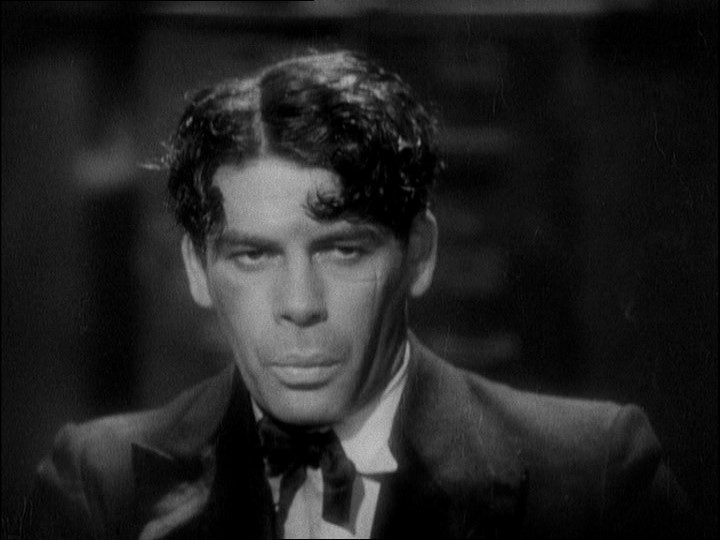
"Hey, Moe, why you no speaka witha your old accent a-no more?"

Boris Karloff, refreshingly not playing a monster, gets a wonderful demise in a bowling alley in another of Camonte's almost gleeful sprees.

Visually, Hawks has fun. The opening scene is an extended tracking shot, moving into a night club as Camonte, unseen by us, starts the killing which will elevate him to the top. The whole opening five minutes or so done in one take, moving into buildings and through walls, witnessing the killing and then moving back out again. The X which appears above the doomed is also a nice if slightly overplayed little device (the moment where we see it above George Raft's head is a cracker), but I suppose, given the time the film was made, this was brand new stuff, along with the brilliant idea of having a machine gun seem to shoot the pages off a calender, forcefully showing the passage of time as Camonte continues his reign of terror.

It's all pre-Code stuff, pretty damn violent for its time and the more than hinted at incestuous feelings Camonte possesses for his sister are quite surprising too, leading to an ending that is derived less from a sense of moral outrage but more from human flaws and desires. Camonte's end is entirely his own doing.

Monday, 1 March 2010

Neil One Year On.

I'm still due my Scarface write-up/thoughts (remember, no in depth analysis!) and more Hawks stuff but real life gets in the way sometimes.

It's been a funny week. Within the space of one day, a friend lost his young brother in law, we marked a year since the passing of Neil and my friends Dan and Elaine Starborg became proud parents.

Last week, we remembered the first anniversary of the death of my friend, Neil Platt. His wife, Louise, had decided we should spread one third of his ashes, according to his will, up on Arthur's Seat which, for the uninitiated, is a large extinct volcano sitting smack bang in the middle of Edinburgh. And so we all trudged up the hill, in the piddling rain and freezing cold, each taking a sip of his favourite tipple, Guinness, and then each took a turn at sprinkling the ashes. There were some tears to begin with but, as he would have had it, these were vastly outweighed by alcohol and laughter. A short pub crawl in some of Neil's old student haunts in Edinburgh brought back good memories and we found some amusing alternative uses to the red boas the Jagermeister girls were handing out in Maggie Dickson's; red being the colour of blood, in the hands of fans of stupidly violent films. Give us a camera and we'll make the best fools of ourselves.

It's affirming to know there is such a strong groups of friends around. Even after all this time, we've not changed all that much. Some of us (including myself) are still as self-indulgently infantile as ever and I thank the Powers That Be for that.

Good times inspired by a good friend.

But the story doesn't end after a year. Louise has updated their blog, The Plattitude, with her thoughts and feelings about loosing Neil to Motor Neurone Disease one year on in a letter to Neil she has decided to share with everyone. It's touching, sobering stuff and brings home just how cruel, unremitting and painful in many ways MND is.

I still can't believe he's gone.

Anyone reading this blog, please try and continue to help raise awareness of MND.

The Motor Neurone Disease Association

Wednesday, 10 February 2010

Kids in Canvas Coffins...


My Hawks Hunt continues with The Dawn Patrol.

I did not expect to like this film as much as I did. In fact there were moments I simply loved. Hawks' first Talkie tells the story of two friends in the First World War as they fly out on bombing sorties in bi-planes over war torn France. The Hawksian theme of brothers in arms and male friendship is apparent from the get go. Richard Barthelmess and Douglas Fairbanks Jr play Courtney and Scotto with what appears to be real warmth. The sense of camaraderie is convincing amongst the men as they face death in the sky with each other, none of them knowing if they'll ever return each time they take off. The men drink (a lot), laugh and sing songs in their makeshift little bar at the airfield, waiting for the next batch of orders to be delivered by Neil Hamilton's Major Brand.

Brand and Courtney are points of antagonism for each other; Brand is a ball of anxiety, receiving orders, under protest, from the higher ups that will send young and inexperienced pilots out to their likely doom. And he has to deliver these orders personally to the squadron, led by Courtney, who does not realise Brand's own conflict over it all and subsequently a huge rift exists between the two men. Mention is made of them falling out over a girl in the past, but this seems unnecessary and is rarely if ever mentioned again. All we need to know is that Courtney thinks Brand is sending these kids out to die himself and hates him for it. Until the tables are turned and Courtney finds himself on the other side of the desk when Brand is promoted. Which in turn leads to a rift between Courtney and Scotto. Circles and circles...

One of the main things that struck me about this was the performances. And subsequent reading up about the film has filled me in. There is a natural feeling to the three main performances. I've only seen Richard Barthelmess once before in Michael Curtiz's The Cabin in the Cotton and I did not like him in that at all; let's be honest, it's really Bette Davis' film. And so when he appeared in The Dawn Patrol, I sank a little. But he's great in it. I've since learned that Hawks actually had a little trouble with the studio over the performances not being...well, loud and stagey enough. It seems that the world was used to and expected over-acting and non-natural sounding dialogue and Hawks received studio notes suggesting that no one would believe the film or its performances. They were dead wrong and the film received an Academy Award for best story.

Douglas Fairbanks Jr has come in for a little stick about his performance but I liked him. He lent the proceedings an air of needed joviality at times, with a hairdo that preceded Jedward by some 80 odd years. I've not seen colour pictures of Fairbanks from the period, but something in me says he had red hair during this time. Just an odd and pointless observation from me.

I;d only ever known Neil Hamilton from somewhere else and it took me some time and brow-furrowing before I realised he played Commissioner Gordon to Adam West's Batman in the 1960's. I don't know if he was trying, but there seemed to be a slightly Scottish lilt to his voice. The other accents in the film vary, with no one truly trying to do any sort of British accent except for the actual Brits onscreen. But the dialogue did seem geared toward that, without going over the score with any "Tally ho's"! One performance that did stick out was William Janney as Scotto's doomed younger brother. He was simply rubbish. The gee whizz factor emanated from him like nausea inducing sun rays.

Obviously, the major selling point of a film like this is the aircraft action. And in fact it took a while for that to really kick off onscreen, and with good cause. Even though it's clear Courtney is the main character, when the planes take off, we stay with Brand, anxiously downing drinks with his head in his hands, waiting for the sounds of the returning planes, counting them in. These were effective moments, boiling the weight and responsibility on Brand down to pretty intimate moments of a man counting the deaths he feels responsible for. And when Courtney takes over, we already know what he's in for.

Great shots of the rickety planes taking off, landing and crashing lend it all a sense of authenticity that is only broken by the fact that the airfield seems to be amongst the scrub of the Californian desert and not Northern France. I love the back projection shot, mixed in with the footage of the aircraft. I don't know, I just like back projection. Even James Cameron got away with it in Aliens. A beaut tracking shot of the planes as they prepare to take off lingers in the mind, Hawks love of aircraft very evident. And the fragility of these planes also comes across as they bounce back to the ground, offering the men inside a brittle security. But Hawks does not concern himself with the politics of war, just the lives of the men who fight it. In that respect, it reminds me at least a little of The Hurt Locker.

All in, a thrilling and compelling take of the realities of those who dare and do. Loved it.

Tuesday, 9 February 2010

Geek Disclaimer

I watched Hawks' The Dawn Patrol last night. I'll do a little write up about it later today. But before I do, I want to make something perfectly clear.

I am not a critic.

Sure, you say. Everybody's a critic.

Well, I'm not a film critic. So don't take anything written here to be an attempt at proper analysis. I was rotten at that kind of thing at film school (I find over-analysis to be...passion killing). I'm just a geek who loves movies in general and this is about improving and educating myself. Getting it down in written form on the blog will likely make it clearer in my head, which is usually about as clear and navigable as a sticky swamp in the middle of the darkest night whilst hidden under a black tarpaulin and blindfolded by Black Meg, the sight stealer.

Yes, I like Blackadder.

So, my thoughts on Hawk's first talkie later today. Before that, I have a script to be writing.

Wednesday, 3 February 2010

Fig Leaves


I wasn't able to get a hold of Howard hawks' first film, The Road to Glory (1926), as it seems it doesn't actually exist anymore.

Bugger.

So, next on the list is Fig Leaves, produced in the same year as Hawks' debut. Unfortunately, and as can be the case with silent films, I've only been able to see about the first 30 minutes of what looked to be an amusing battle of the sexes comedy. And I'd better get The Flintstones references out of the way before I carry on; just about every article I've read in the film so far makes mention of the obvious connection. The film is book-ended with scenes set millions of years ago featuring Adam (George O'Brien) and Eve (Olive Borden) dressed, naturally enough, as cavemen. But no primitive fires and huddling in wet caves for this pair - life is lived in much the same way as it is during the film's contemporary scenes. Nice little gags involving coconut-dropping alarm clocks run by sand instead of clockwork and buses pulled by dinosaurs (large scale mechanicals by the look of it, or with performers inside). Yes, yes, yes, so far so Flintstone. I wonder what Hawks' reaction to Hanna and Barbera's cartoon was. Quiet amusement, I imagine.

The prehistoric scenes frame a modern day story (1920's) about a very similar couple, also named Adam and Eve and played by the two leads mentioned above. Eve wants to go out and work, but he's having none of it. Arguments ensue and slithery, serpent-like characters neighbour Alice and fashion designer Andre appear on the scene, each plotting to steal Eve and Adam respectively for themselves. Alice's devious nature is already suggested by her original appearance as the serpent in prehistoric Eve's life but, instead of tempting her, they gossip.

That's about as far as I was able to get given the limited scenes available to me. Themes about the predictability of the attitudes of the sexes to each other and their particular wants and desires are presented in ways very much of their time but Hawks' general representation of women throughout his career is established early on here, an example being Adam insisting on a seat on the dino-bus from a young lady (what a gent!) and her subsequent "We'll get our rights one day" line. If anything, the men do appear dafter, including the Troughtonesque Heine Conklin as Adam's assistant, who provides some laughs in a scene where he tries to convince Adam to get firm with his woman and squirms away when Eve shows up.

But the most Hawksian element, even in a silent, is the quick fire dialogue. We don't always hear what they saying but we know exactly what it is, regardless of the title cards. And Hawks also has some fun with his cards, giving a drunkenly childish Adam a great visual moment by playing around with the font. I actually laughed out loud at one moment where Adam, in response to Eve mentioning a fig leaf sale, replies, "Somehow I can't get hysterical over that".

A funny little film which I like to see the rest of sometime.

Tuesday, 2 February 2010

Doing Hawks


No, it's not an obscene riff on raptors.

I've decided to learn more about Howard Hawks, my interest having recently been aroused by a book of interviews with him (his mildly amused reaction to the passion of Nouvelle Vague interrogators Truffaut et all is interesting). He's someone I've know about since a kid, hearing my childhood film heroes talking about his influence on them and, having already seen a couple of his films in the past, I'm now on a mission to see and learn as much about him as I can.

Oddly enough, I'm not a fan of his later westerns (all the same film, it would appear) but I hope to see them more in context with the rest of his work; Rio Lobo and Bringing Up Baby are a million miles apart to me. Maybe it's Hawks' versatility that is the most interesting thing of all.

From what I've already gleaned, some of his earliest films, particularly the silents, may be tricky buggers to track down and I want to do this as chronologically as possible. Any help or info would be lovely.

There are some fragments of his first film, Road to Glory, somewhere. Here we go...