

The title line of this blog was not uttered by Joe Pesci, as might be obvious to some (well, me until recently) but Paul Muni as incestuous and brutal gangster Tony Camonte in Hawk's Scarface, predating Pesci's terrifying Tommy DeVito but some 60 years or so.
Ages ago I set out to try and see as many of Howard Hawks films as I could and the reader could well be forgiven for thinking that I'd let the task fall to the wayside. But no, it's just taking a while to obtain the films, see them and have the time to blog about it.
So, since my last Hawks blog I've managed to squeeze in a few more. Unfortunately I missed an opportunity to see The Crowd Roars, Hawks racing drama with James Cagney and Joan Blondell, so that will have to wait for another time. But before that I did get a look at Hawks' Scarface.
One of the earliest and well regarded gangster films of the wave which hit in the 1930's, it was stopped at the gates for a few years after production owing to a disagreement between Hawks and producer Howard Hughes about which ending to use. Hawks' original ending, where Muni's Tony Camonte goes out in a hail of bullets after killing his sister, was re-instated after Hughes' alternative involved Camonte giving himself up to police, going before the judge and being hanged, all without a glance at his face as none of the shooting involved Muni. The alternative ending is available on the DVD and is just rotten but does provide an little insight to the fear some filmmakers might have felt at the time about the violence they were portraying; no one could go out with a bang and justice had to be seen to be dealt out by society.
With that in mind, the end of William Wellman's The Public Enemy, where James Cagney's character of Tom Power's bound corpse (it seems wrapped up like a mummy) looms dramatically into frame as his brother opens the door, is far better in my mind, a pretty startling end that didn't give in to the moral authorities demands that they be seen to be dealing with the problem. Death is death in these matters and the unseen but well expected effect Cagney's character's death would have on his mother has far more impact than the weight of the law ending his life.
But then again, I'm biased as I'm a Cagney fan and love The Public Enemy. The theme of the film, I'm Forever Blowing Bubbles, was a song my grandfather used to sing to me as a very small child (he died when I was 3) and hearing the version used in the film gives it a brilliantly horrid but touching edge. The enduring love of a mother for a son she has brought up but who has become something evil. Nice and tragic balance.
Muni, on the other hand, is effectively greedy and brutal by turns but seems to be overdoing it a lot of the time as well. His accent makes the Italian Chef from The Simpsons look like the antithesis of the stereotype, wandering into the comedic at times. But one of the things I like about Scarface is its balance, or possible lack thereof, between the brutality of Camonte's activities and the absurdly comedic. His secretary, Angelo, is a comic relief character bordering on the ridiculous at times, providing a levity in the proceedings I can't imagine the moral authorities tolerating much at all. But things like this can emphasise the sudden switches to violence, giving Camonte a sense of unpredictability that, say, Cagney's Tom Powers might not have possessed.
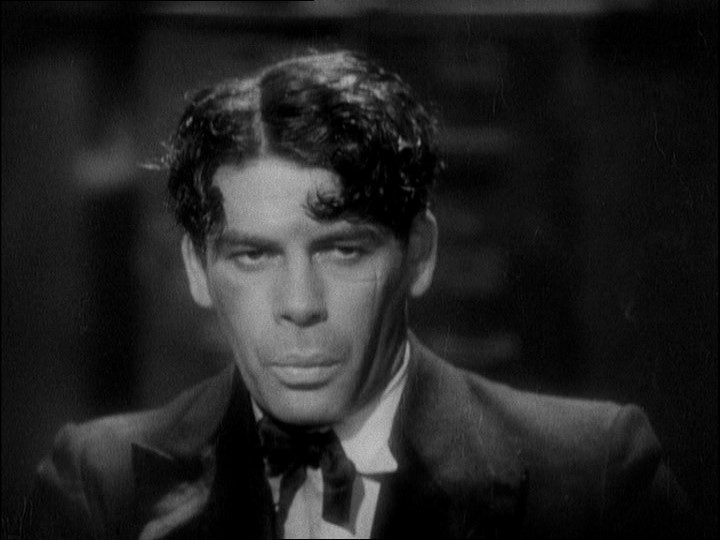 "Hey, Moe, why you no speaka witha your old accent a-no more?"
Boris Karloff, refreshingly not playing a monster, gets a wonderful demise in a bowling alley in another of Camonte's almost gleeful sprees.
Visually, Hawks has fun. The opening scene is an extended tracking shot, moving into a night club as Camonte, unseen by us, starts the killing which will elevate him to the top. The whole opening five minutes or so done in one take, moving into buildings and through walls, witnessing the killing and then moving back out again. The X which appears above the doomed is also a nice if slightly overplayed little device (the moment where we see it above George Raft's head is a cracker), but I suppose, given the time the film was made, this was brand new stuff, along with the brilliant idea of having a machine gun seem to shoot the pages off a calender, forcefully showing the passage of time as Camonte continues his reign of terror.
It's all pre-Code stuff, pretty damn violent for its time and the more than hinted at incestuous feelings Camonte possesses for his sister are quite surprising too, leading to an ending that is derived less from a sense of moral outrage but more from human flaws and desires. Camonte's end is entirely his own doing.


