Showing posts with label James Cagney. Show all posts

Monday, 28 June 2010

Hawks Blog - "Whaddaya mean ya think I'm funny?"


The title line of this blog was not uttered by Joe Pesci, as might be obvious to some (well, me until recently) but Paul Muni as incestuous and brutal gangster Tony Camonte in Hawk's Scarface, predating Pesci's terrifying Tommy DeVito but some 60 years or so.

Ages ago I set out to try and see as many of Howard Hawks films as I could and the reader could well be forgiven for thinking that I'd let the task fall to the wayside. But no, it's just taking a while to obtain the films, see them and have the time to blog about it.

So, since my last Hawks blog I've managed to squeeze in a few more. Unfortunately I missed an opportunity to see The Crowd Roars, Hawks racing drama with James Cagney and Joan Blondell, so that will have to wait for another time. But before that I did get a look at Hawks' Scarface.

One of the earliest and well regarded gangster films of the wave which hit in the 1930's, it was stopped at the gates for a few years after production owing to a disagreement between Hawks and producer Howard Hughes about which ending to use. Hawks' original ending, where Muni's Tony Camonte goes out in a hail of bullets after killing his sister, was re-instated after Hughes' alternative involved Camonte giving himself up to police, going before the judge and being hanged, all without a glance at his face as none of the shooting involved Muni. The alternative ending is available on the DVD and is just rotten but does provide an little insight to the fear some filmmakers might have felt at the time about the violence they were portraying; no one could go out with a bang and justice had to be seen to be dealt out by society.

With that in mind, the end of William Wellman's The Public Enemy, where James Cagney's character of Tom Power's bound corpse (it seems wrapped up like a mummy) looms dramatically into frame as his brother opens the door, is far better in my mind, a pretty startling end that didn't give in to the moral authorities demands that they be seen to be dealing with the problem. Death is death in these matters and the unseen but well expected effect Cagney's character's death would have on his mother has far more impact than the weight of the law ending his life.

But then again, I'm biased as I'm a Cagney fan and love The Public Enemy. The theme of the film, I'm Forever Blowing Bubbles, was a song my grandfather used to sing to me as a very small child (he died when I was 3) and hearing the version used in the film gives it a brilliantly horrid but touching edge. The enduring love of a mother for a son she has brought up but who has become something evil. Nice and tragic balance.

Muni, on the other hand, is effectively greedy and brutal by turns but seems to be overdoing it a lot of the time as well. His accent makes the Italian Chef from The Simpsons look like the antithesis of the stereotype, wandering into the comedic at times. But one of the things I like about Scarface is its balance, or possible lack thereof, between the brutality of Camonte's activities and the absurdly comedic. His secretary, Angelo, is a comic relief character bordering on the ridiculous at times, providing a levity in the proceedings I can't imagine the moral authorities tolerating much at all. But things like this can emphasise the sudden switches to violence, giving Camonte a sense of unpredictability that, say, Cagney's Tom Powers might not have possessed.
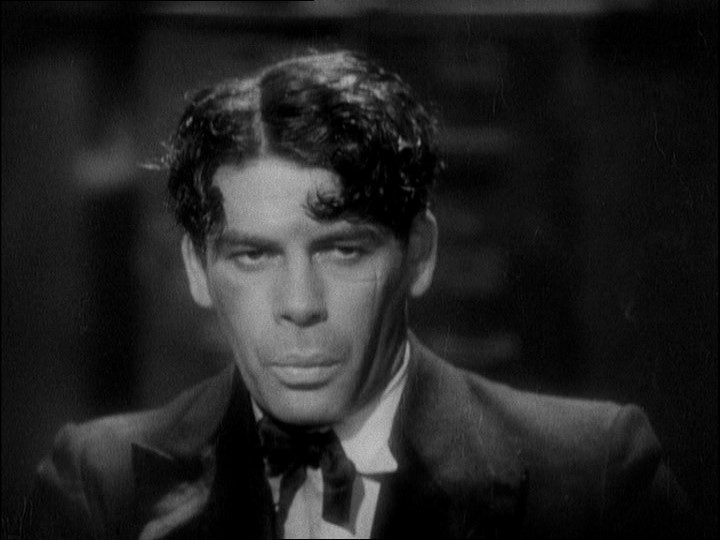
"Hey, Moe, why you no speaka witha your old accent a-no more?"

Boris Karloff, refreshingly not playing a monster, gets a wonderful demise in a bowling alley in another of Camonte's almost gleeful sprees.

Visually, Hawks has fun. The opening scene is an extended tracking shot, moving into a night club as Camonte, unseen by us, starts the killing which will elevate him to the top. The whole opening five minutes or so done in one take, moving into buildings and through walls, witnessing the killing and then moving back out again. The X which appears above the doomed is also a nice if slightly overplayed little device (the moment where we see it above George Raft's head is a cracker), but I suppose, given the time the film was made, this was brand new stuff, along with the brilliant idea of having a machine gun seem to shoot the pages off a calender, forcefully showing the passage of time as Camonte continues his reign of terror.

It's all pre-Code stuff, pretty damn violent for its time and the more than hinted at incestuous feelings Camonte possesses for his sister are quite surprising too, leading to an ending that is derived less from a sense of moral outrage but more from human flaws and desires. Camonte's end is entirely his own doing.

Thursday, 8 January 2009

Ticker Update and My Own Stupidity


I got a few nice messages from some friends when I posted about my experience with a 24 hour heart monitor back in November. Well, by default, I can now say that I'm fine. I say default as a letter wasn't sent to me by my doctor as there was nothing to tell me. Except that I'm fine. So, for two months of worry and stress about the possibility of heart disease, turns out I'm fine and it's likely down to stress. My local practice told me that they don't send out letters to patients as they'd be doing it all day and it's the hospital's job. The hospital say it's the practice's responsibility. Somewhere, there are patients wandering about in a confused daze.

Idiots.

I got a few more details when I contacted my local GP and the receptionist read out the letter, or mumbled it to me. It might have been a Ventricular Ectopic beat, where the heart's lower chamber can jump sometimes. For folks with heart disease, it's a harbinger of doom. For folks without heart disease, cut down on the stress and caffeine. And booze. I fall into the latter category, thankfully. Due my family history, I get my blood pressure checked regularly and all is well.

Relieving to know. I might also cut down on the booze as I had a few extra at the weekend and wound up leaving my bag in a taxi, containing my notebook (pretty fucking necessary for a writer, don't you think?), DVDs bought in the January sales (No Country for Old Men and another Cagney box set), my glasses and my digital camera which cost me £130 a year ago. Was I angry at myself? Yer right I was. Fuckybaws. But entirely my own fault. This Saturday's trip to Glasgow might be a sober one. I've not made my mind up avout that yet.

The Cagney viewings will continue, however, as the lost box set was cheap enough to buy again. I'm also going to be following David Cairns' new weekly Hitchcock blogs, watching as many Hitch flicks as I can on a weekly basis. If you love films, I can't recommend David's blog enough. Go and check it out.

So, time to forget about material loss - there are far worse things which can happen. Onwards with the writing, film watching and film making.

Sunday, 4 January 2009

What was his Business?

The Roaring Twenties. Saw it years ago as a teenager and was my first proper look at the gangster film as defined by Cagney and Bogart. I was surprised at the time to see Bogart in what was essentially a supporting role but even more surprised to see him playing a snivelling weasel who turns yellow when Cagney has him at the end. I found him surprisingly good in this different type of role.

Watching it again, while I still enjoy Bogie's part, it's Cagney who rules, and rightly so, in this tragedy of a decent man who finds himself forced into the wrong side of the law by a combination of elements beyond him. Not welcomed back as the war hero he is, chided by those who stayed at home and jobless, this still doesn't overtly criticise the lack of support to returning troops by home and government but at least began to address the issue before the extreme jingoism of the Second World War took a hold of the US, which would have made this an unconfrontable issue at the time. I haven't seen Best Years of Their Lives, but this has put me in a mind to watch it.

The Roaring Twenties also gives Cagney another superb ending, after falling in to his mother's house all dead and wrapped up in The Public Enemy and after his ambiguous final act of redemption in Angels with Dirty Faces. It's a far swifter end, as Cagney's Eddie Bartlett staggers on to the wide church steps to breathe his last. But the final glorious line bypasses him and goes to the equally tragic but far more aware character of Panama, played by Gladys George. When asked by the officer on the scene what Bartlett's business was, she sums him and his end up as honestly as she can.

"He used to be a big shot."

An undignified end for the big man, framed small against the vast steps. Almost like he is laid open before his god, ready to be judged.

A clue to Bartlett's possible knowledge of his situation with regards to his position and love life can be seen in his holding hands with Panama, even as he admires his girlfriend Priscilla Lane singing in the speakeasy. As though, yeah this life is great right now, but deep down he knows that Lane doesn't love him and he knows he's kidding himself.

Lovely stuff. I'm finding out more and more of the tragic nature if Cagney's gangster roles. White Heat next and I may give The Public Enemy another go.

Friday, 2 January 2009

That Cagney Swagger


James Cagney's swagger truly caught my Christmas strained eyes whilst watching Angels with Dirty Faces last night. Both hands held slightly out in front (very slightly), swinging stiffly from the shoulder, as his legs pipped along. He keeps this gait as he walks the last mile to the chair, a moment that really got to me, even though I'd seen the film years before and knew what was coming.. The hall is wide and sparse and Curtiz cuts between closer shots of Pat O'Brien barely taking his eyes from his childhood friend as Rocky Sullivan's eyes stay as fixed as his resolution not to go "yellow" and wider shots where Cagney's swagger is displayed for all to see in. It's a hell of a moment and got me slightly emotional, which is usually and odd thing for a film as old as this.

The opening shot of Rocky's neighbourhood is also an absolute cracker, as the camera pans right to left from a close up on a newspaper headline to a wide angle across the incredibly crowded and busy street, it''s walls a moving painting of dozens of beaten rugs and hanging laundry. A simple camera movement capturing a bravura piece of onscreen organisation. It's repeated later on to effectively show the passing of time in the neighbourhood. The newspaper headline, music and cars have changed but the rugs and laundry across the fire exits and balconies still remain.

Another thing I love about this film is the casting of faces. The Dead End kids all have a different look, especially Leo Gorcey as Bimm, who I always thought looked a bit like Cagney (this film has more than one Cagney lookalike in the uncanny Frankie Burke, who played the young Rocky). Gorcey takes a shot at the pool table, dressed to the nines and surrounded by similarly aged extras as onlookers, only perhaps better looking by today's Hollywood standards.

If this was cast today, the bland pretty boys would be likely be cast as the Dead End kids, leaving the more interesting and far more cinematically photogenic faces in the background or perhaps even not cast at all.

On to more Cagney methinks.