Thursday, 5 October 2017

October Horror Day 4 - Horror Hospital

Holy shitbiscuits! What did I just witness?

I'm trying to go for a range of titles (verging on random, to be honest) and picked up Horror Hospital (1973). The image of UK genre stalwart Michael Gough on the cover drew me to it. The additional image of Robin Askwith on the cover sealed the deal.

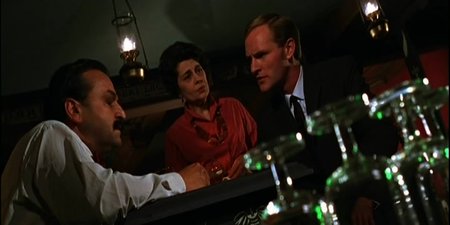
Horror Hospital is a horror comedy, aiming for an exploitation feel (director Anthony Balch had previously been a distributor of exploitation movies in the UK)  that seems to forget this mix and takes itself somewhat seriously at random points. The laughs don't exactly occur where they're intended to. The story follows Askwith's Jason Jones (got to have a bit of alliteration for the hero) as he abandons an attempted career in music for some time away at what he thinks is a health spa, all arranged by dodgy character Pollock of "Hairy Holidays" (a clearly frail Dennis Price who was consumed by alcoholism). En route he meets Vanessa Shaw's Judy who is heading to the same destination to meet her Aunt Harris (named so because she liked to wear Harris Tweed, something never ever referred to again afterwards) who is executor to Judy's late mother's will (something never ever referred to again afterwards).

"All a bit rubbish, isn't it?"
Their "meet cute" consists of Askwith complaining he's not eaten that day as he phwoars at Shaw eating her lunch but promising that he's "not going to rape" her. She is fine with this.

Onwards.

Upon their arrival at the "health farm" they are met by Skip Martin's dwarf henchman, Frederick, acting like an even weirder version of Richard O'Brien's Riff Raff. Martin, already famed from previous horror movies such as Corman's Masque of the Red Death, gives a wonderfully odd performance, at times seemingly not in control of his eyes or grin and at others like he's fighting back tears. A lovely man who everyone liked and was up for anything from all accounts on the Making Of doc on the disc. His character is pretty tragic. They soon discover other young people there, lured the same way Askwith has, now mindless slaves after brain experimentation. Cue the usual scenes of capture, amusing deaths and thwarted escapes until Askwith and late arrival Kurt Christian (who I recognised from Sinbad and the Eye of the Tiger) save the day with Frederick's help. Things go boom, there's a sudden monster and some smoking deadly quicksand (in the UK...) before deaths are forgotten about after a cheeky fright gaga from cheeky Askwith.

It was around 20 minutes in that I was compelled to pour myself a drink.


Askwith is channelling, well, Askwith. This was just before he embarked on the most popular/notorious section of his career with the Confessions films and his cheeky chappy persona is already winking his way through the proceedings here.  His character starts out as an annoyed "cool" 20something who's after a shag (and so begins Askwith's career); he and Lewis have known each other less than a day before they're not only in bed but comforting each other as though they're Jonathan Harker and Mina Murray. Lewis' lack of acting experience is apparent, let's leave that at that. Askwith instantly develops into a heroic leading man when the film calls for it, which is, frankly, a very odd thing to see. During a big escape scene, two burly guards in biker leathers catch him, beat him with coshes and pull at his t-shirt as he screams like a child at regular intervals. I wasn't sure how deliberate this was and this confusion was further fuelled by moments where screams are quickly repeated over the same footage, which reeked of laziness as opposed to an intended effect. Some of Skip Martin's dialogue is just downright bizarre but which also makes his character the most interesting.

Gough loses the Zero Mostel lookalike contest.

British stage actress Ellen Pollock appears as the villainous Aunt Harris, channeling a combination of Norma Desmond and Irma Bunt. Her character's sudden and not at all believable change of heart results in an odd scene where she packs to leave, grabbing random objects from around her room and shoving them into a suitcase. She seems to have an unexplored love of creepy dolls.

The unevenness of these two scenes are reflective of the whole film which tries to mix spoof with a love of exploitation and z-grade films but ultimately fails. But part of the problem is director Anthony Balch's inexperience. This was only his second film after spending years making experimental films and collaborating with William Burroughs - it appears during that time he never really learned how to direct a narrative film. It's all inept stuff and you really wonder why Michael Gough is in this. Gough, you say? The same Gough who was daft enough to appear as a mad scientist in Konga? This sorry affair makes Konga look like King Kong. It's telling that Gough wouldn't speak about this film at all once it was finished. His presence does sometimes lift the proceedings and his character is directly derived from some of Bela Lugosi's characters from the sad end of his own career - director Balch was a Lugosi fan and asked Gough to watch The Devil Bat (1940) to understand what he wanted. Gough's mad Dr Storm is clearly inspired by Lugosi's mad doctor from Ed Wood's Bride of the Monster (1955) but his intentions involving the young people whose brains he's tampering with to create mindless slaves is never made all that clear.


Balch's use of music is equally odd and inept. The titles proudly proclaim the film's music to be done by De Wolfe, they being a music licensing company. Consequently, Balch's £22,000 budget has possibly squeezed his musical choices, but in any event his use of music is odd. There are moments where he lets the music define the cutting of some scenes, which does not work at all. The scene where Aunt Harris packs her suitcase has a long, sad score that suddenly ends while the scene continues for a bit longer. That is, until Aunt Harris is dispatched by the film's monster, a large misshapen thing seemingly made of wax (well, that's how it looks) and which turns out to be... maybe not spoil that bit, but the reason for this character's physical transformation is never explained. The use of De Wolfe, for this Monty Python fan, also fooled me into thinking that a fight scene in a leafy wooded area was about to be invaded by John Cleese and Graham Chapman's Black Knight and King Arthur. The inconsistencies of the music help no one.


Amusing trivia: the exteriors of Dr. Storm's hospital were shot at Knebworth House, the same location where Michael Gough would find employment as Alfred Pennyworth some 16 years later where it doubled for Wayne Manor in Tim Burton's Batman. Famed UK stunt performer Colin Skeaping, who doubles for Mark Hamill is the original three Star Wars films, also fills in several roles as various motorcycle leather guards and a lobotomised youth.

At the wrap party, leading lady Vanessa Shaw (actually called Phoebe Shaw) made a cake for the cast and crew. Laced with drugs. One wonders what had been passed around before filming started.

Horror Hospital is one for a late night and some booze. Maybe some small objects to throw at the screen. I mean, where else can you see Dennis Price decapitated by a Rolls Royce?

Wednesday, 4 October 2017

October Horror Day 3 - Eyes Without a Face

Director Georges Franju said that his 1960 production of Eyes Without a Face was not a horror but was more concerned with anguish - this is understandable. I don't think horror can ever be defined into a hard category. The range of human emotions, which horror cinema taps into perfectly, is too broad to let itself be defined in narrow terms. Cheap scares and a night spent picking up spilled popcorn from jump scares is all and well but I find the best horror films are the ones that get under your skin (if you'll pardon the expression) and play with our pre-concieved notions about what it means to be human and how we face mortality. Like any literary genre, a film genre should always look to push its own boundaries, both in terms of shock and emotion and in it's exploration of ideas. Eyes Without a Face looks to mythological and fairy tale imagery. I can't help but think about Guillermo del Toro when I watch it.

Eyes Without a Face is fantastic.

From the wordless opening, where Alida Valli drives her lifeless passenger (revealed to us as she moves her rear view mirror) to a watery grave, accompanied by Maurice Jarre's twisted fairground parody (in fact, this theme accompanies Valli whenever she's up to no good in the film), like a helter-skelter slowly descending into a distant hell. Jarre's score is wonderful, used sparingly (a complete absence of music during the Doctor's final scene is powerful) and clearly features musical snippets he would return to in Lawrence of Arabia and Doctor Zhivago, Christiane's sad theme in particular.


The anguish comes from both Pierre Brasseur's obsessed doctor and his disfigured daughter, Christiane, whom he hides from the world, her face hideously damaged by a car accident. Doctor Genessier has sent his secretary, Louise (Valli), out to abduct young women so he can remove their faces in an attempt to give his daughter back her beauty. He is a man driven by a quiet anguish and a scientific determination, like all the best villains, the protagonist of his own story. He wants his daughter returned to him, as he managed for Valli in restoring her own face. Valli is almost the Fritz/Igor to Brasseur's Frankenstein, as she sets about her grim tasks with unquestioning loyalty and a lack of anything resembling morals. The good doctor and his assistant are a bit underwritten - her loyalty to him and the absence of Christiane's mother might suggest a relationship between the two but it remains unexplored. This is not to say that their relationship should be so, but they do seem a bit flat in that regard, Louise especially. Is her loyalty to him (and therefore willingness to commit terrible acts) simply out of gratitude? In this respect, she seems worse than him. He seems to act out of love for his daughter (twisted and morally corrupt as he clearly is) whereas Louise only shows any sense of fear or guilt near his family tomb, focusing on a passing plane to drown out the noise of his digging. Even Dwight Frye's Fritz was a willing digger for Henry Frankenstein. Her apparent lack of morals is odd and Franju even gives Doctor a chance at sympathy with the audience through his care towards the patients in his hospital. However, anyone who experiments on animals is a c*nt, in my book. Through and through. His demise, reminiscent of the fall of Doctor Moreau or Dr Frankenstein in James Whale's classic, is fitting.


Franju was skirting a fine like with his treatment of the actual tissue graft. This film was made in 1960 and the scene of skin being cut and visibly lifted from a character's face must have been shocking at the time. It still made me squirm somewhat, even if the face on the move does look a bit white and rubbery. It's bold stuff for its time. I've read that some critics derided the film as disgusting but the sense of quiet desperation and, indeed, anguish is palpable through the film. Horror shouldn't be afraid to play on emotions other than straight fear.


Edith Scob's Christiane is kept mostly behind a mask, seemingly cast from the actress' own face, so natural does it appear. Her sad visage is truly haunting and at times is one of the saddest images I've seen in a film for a long time. She moves like a ballet dancer (as noted by my wife) and her first scene features her dressed in a long raincoat, buttoned up to her neck. She appears doll-like not only in her face but her entire being. Even the scenes where we see her new face, her face exhibits an otherwordly yearning with those giant, sad eyes. Her final scene, accompanied by white doves, is reminiscent of Snow White but far sadder and consumed with a despairing madness. It's an image I'm not going to forget in a hurry.

Tuesday, 3 October 2017

October Horror Day 2 Pt 2 - Theatre of Death


I think we bought this years ago from a charity shop under the mistaken belief that it might have been the vastly superior Theatre of Blood, starring good old Vincent Price. It's been sitting on a shelf for a very long time and, well, should it have stayed there? I certainly didn't hate it but it doesn't seem all that sure of itself. And it commits the crime of wasting Christopher Lee.

Lee's Phillipe Darvas runs the Théâtre de la Mort in Paris, kind of an updated (for the 60s) take on the Grand Guiniol where the middle classes would flock to see various sketches that portrayed the apparently realistic deaths of those onstage in a variety of highly grisly ways. A bit like an Alice Cooper gig. An ongoing spate of murders is occuring at the same time and Darvas' arrogance and cruelty to his actors is earning him a reputation that places him under suspicion as the serial killer (a phrase never uttered in the film). That is, until he himself goes missing. All of this is delivered through the sighs of Leila Goldoni's actress, Dani, and her professionally convenient policeman boyfriend, Charles, played by Julian Glover. At the centre of all of this is new member of the troupe, Nicole (Jenny Till) who spends part of the film hypnotised by Lee's maniacal director and is gradually brought out of it by Dani and Charles. But her enigmatic character doesn't end there, even though her final reveal is kind of pointless as it's hard to care about her. In fact it's hard to care about anyone in this film.

Lee is his usual grand self but disappears halfway through, his murder only signified by a couple of lovers on the Sienne who find his grey and dead hand/arm which does not seem to be attached to anything; whether or not this is deliberate is up for debate. It seems that Lee's complete absence from the second half of the film indicates a certain frugality of budget; they had him for a small amount of time and couldn't afford him anymore?

Goldoni's character proves effective enough at expressing a reasonable fear of being harmed onstage but her character's history seems shoehorned in so Lee can shout at her and the murderer can frame her very late in the game. Glover's police officer is at once charming and suspicious of everyone but there come several moments where director Samuel Gallu shoots him with his own suspicion of him in mind. I was convinced at one point that he was in the frame and yet nothing narratively was done there. Even his superior, Ivor Dean, famous as the long suffering lawman who had to deal with Roger Moore's Simon Templar and Jeff Randall in Randall & Hopkirk (Deceased), has a moment where the audience might even suspect him. And yet nothing is done with these moments, depriving the film of any sense of paranoia on the part of the Goldoni.


Gallu also has a bit of a predilection for framing characters to the extreme side of the frame, at times warranted at other times not, and for shooting from low angles. Fair enough to make the tall Lee seem even more imposing and interesting during a Tarot reading where the cards, on a glass table, seem to float in the air providing the audience with a spot of dramatic irony, particularly regarding one character. At other times, the low angles sprinkle in here and there for good or ill. It's all a bit meh, considering the story revolves around Grand Guignol and yet chooses to spend more time on the piddling love story.


At least the climax occurs around a performance at the Theatre de la Morte, but the villain's end, set up earlier on, appears ot be an accident, a scene pushed forward by the tense diegetic drum beat of the performance, even if it does involve some rather racially ropey voodoo dancing, with once performer revealed to have been blacked up. The flippance with which it does this is kind of amusing and amazing at the same time.


It;s a bit of a disappointment and one that wastes Lee. At least there as a scene for this child of the 80s where two Bond villians/Star Wars villains got to share the screen. Scaramanga would have made mincemeat of Aristotle Krystatos.

October Horror Day 2 Double Bill Pt 1 - The Lost Boys


 I never saw The Lost Boys when it come out in UK cinemas in 1987. I was 14 but looked 10 years old so there was no chance I was sneaking into a cert 15 film. And yet, when it came on UK TVs on the Christmas of 1990 I think it was the right time for me to see it. I was too busy with Joe Dante, Krull's re-release (bite me) and Spielberg's Amblin films which seemed to be on regularly at the ABC on Lothian Road. Ah, Saturdays...

I was a fragile child and would likely have been put off by some of The Lost Boys - I just didn't connect with teenagers when I was one. By 1990 I was in my final year of high school and, after years of bullying and ostracism, had finally learned precisely how to tell the world to "fuck off" and I was finally getting into music that wasn't movie soundtracks. Frowns were the order of the day ("Smile, Brian!" "Fuck off.") and the time was right for me to appreciate Joel Schumacher's tramp-chic take on vampires and JM Barrie. Not literally Barrie, per se, but I believe the original idea had been, "What if the Lost Boys in Peter Pan never grew up because they were vampires?"


I said before that this season of blogs is about horror movies I've not watched before or at least not watched for a long time. We figured out it had been a lot longer than I thought since I last watched The Lost Boys, although I'm sure some late night drinking session has ended up in the Banshee Labyrinth, in Edinburgh's Old Town, watching it in the cinema there. And yet, I can still insta-quote the film as irritatingly as I could back in the 90s. It's all still there: the rice maggots, motorbikes in the fog, the Frog brothers and their comatose parents, Corey Haim's relentless cheeriness, that reveal, the "Attack of Eddie Munster" and Barnard Hughes final line (my teen self couldn;t help thinking, !Mr Merlin!" upon seeing him. It's probably me and my age but I hasn't aged as badly as it might have, with the obvious exception of Corey Haim's wardrobe, Edward Herrman's jackets and that ridiculous oiled up muscle dude singing with his sax on the beach which surely must rate as one of the most 80s things ever put to film. Crazy sax dude aside, the soundtrack still seems relatively fresh (OK, it's my age); Echo and the Bunnymen's cover of People are Strange (produced by Ray Mazarek, no less) hits exactly the right note. But the less said about Roger Daltry's cover of Don't Let the Sun Go Down On Me the better.

"Something for the weekend, sir?"
The Lost Boys isn't particularly scary, but I will argue that since it is about vampires and people are killed that it is indeed a horror film; the scene at the beach bonfire where Keifer Sutherland's David reveals the gang's true nature to Jason Patric's Michael is an explosion of quickly cut vampire mayhem, with arms ripped off, bald heads bitten into and corpses sizzling on a fire, the aftermath mixing Michael's conflicted revulsion and David's gluttonous appetite clearly sated. Sutherland wipes away what could be a bit of food from the side of his face as though he's just finished a pie eating contest. And Schumacher and his DP Michael Chapman know exactly how to light Sutherland's baby-faced features, giving his appearance real menace and an otherworldy quality. Sutherland's casting is superb. Much of the other casting revolves around the teen idols of the time or pretty faces, alas, with the exception of the Frog brothers. But one gripe I do have with the film is that there doesn't seem to be a main character. Arguably, it's Michael but its hard to care about him, especially when his brother shows him up so spectacularly. Herrmann's Max is suitably sympathising which gives more power to his reveal at the end. And yet, is that what everyting's been about? His speech about family doesn't hold that much water when the rest of his scenes with the gang have been antagonistic.


The film's imagery homages many other movies, notably Psycho with it's predilction for taxidermy with sprinlings of Mad Max through the denizens of Santa Carla and their home made couture. There is a feel of twisted nature to it through the use of gnarled wood in much of the production design, notably, Barnard Hughes home and the vampires' lair. Any of the plastic artifice so synonymous with the 80s is reserved for Max's video store, which the film doesn't seem too keen to spoend a lot of time, instead opting for a grubby nostalgia for times past on the boardwalk. The vampires' victims are shot from above, often very high above, giving us a flying vampires-eye-view of their prey without going to the expense of sticking the actors unconvicingly on wires, something kept for the final showdown between David and Michael among the rafters of his grandpa's home, all kept in shadow and quick cut close ups, a nice bit of cineman to mask any budget deficiencies. I prefer it that approach - nowadays, it's all "easy" and I feel so much is lost of any impressionism cinema can still pull off - it's an emotional experience and we don't necessarily perceive the world in grand, open shots when action is called for, even though some filmmakers take quick cut, close up action way too far these days (oh shit, I'm a grumpy old guy!). Schumacher knew what he was doing with this movie, full of knowing winks without ruining the artifice. The image of a floating boy at the window from Salem's Lot is nicely homaged through one of the film's most famous scenes and endlessly quotable lines that would have been manna from heaven for the film's marketing people and was ideal for its audience:


"My own brother! A goddamned, shitsucking vampire! Well, you wait til mom finds out, buddy!"

October Horror - Day 1: The Pit & the Pendulum


Yep, I'm aware it's the 2nd of October. But we kicked off October horror last night so I'm writing up this post a day later. And so what did we (my wife is in on this) choose to get things going? We went with some classic Vincent Price. Some of his most famous work was with the legendary Roger Corman and their Edgar Allan Poe series. Fopp have a cracking sale on at the moment and I snapped up a bunch the recent Arrow Corman/Poe titles last week. I like to try and go in chronologicla order with these things so The Pit and the Pendulum (1961) was the earliest of the titles I bought.

The image of Vincent Price hovering maniacally nearby while said pendulous blade swings back and forth, close and closer to our hero's torso is an enduring one but there is a lot more to the film than just that. Price's character, Nicholas Medina, begins as a mysterious but ultimately sympathetic character, wracked with grief and eventually misplaced guilt at the loss of his wife, Elizabeth, played by Price's equal in horror, Barbara Steele. Along comes Elizabeth's brother, Frances, looking for answers upon receiving the terrible news. Of course, nothing will seem as it appears on his arrival.

John Kerr plays Frances sporting a permanent pouty frown, whose only other expression seems to involve opening his suspicious eyes wider every now and again. It's difficult to give a toss about him, particularly once the now insane Nicholas has him strapped beneath his monstrous pendulum (oo-er missus). This in stark contrast to Price's performance, which drives the film, ranging from quiet dignity in his grief to bug-eyed histrionics, especially once certain forces begin to finalise their plan to drive him mad. Price's entrance into the film is a great sudden close up when he bursts out of a secret room, uttering the demand, "Who are you?" to Kerr's new arrival. It's this adulterous plot that is revealed in the film's final act, set up to mirror the awful fate Nicholas' father set out for his own wife and her lover. Seeing as it didn't go so well for them, surely the effort to drive insane a man obsessed with his murderous father rates among the poorer plots in horror? Nonetheless, Price duly takes up his character's new outlook with suitable aplomb, as he slowly lowers the pendulum in an attempt to slowly bisect Kerr's Frances - cases of mistaken identity jump around as one person dies only for Price to believe that the next live soul is the same target. He manipulates the awful device with such glee that he could be twirling his ever present moustache while Kerr writhes tied up to a trainline in an old silent. He's marvellous and his performance is a solid reminder of the pathos Price could give us, albeit on an exagerrated scale here.


Luana Anders does fairly well as Nicholas' sister, a role that begs for development. Of course she winds up with Frances, but who cares? It's not that Price just dominates the screen, but that her role as sister isn't all that believable. Her eyebrows, on the other hand, would give Kim Novak's in Vertigo a run for their money; they're just odd. Antony Carbone lends the proceedings a slightly more jovial air early on while Barbara Steele, not onscreen all that long, makes her presence well and truly felt, those big eyes exuding evil and fear in equal measure. She's great. And the reveal of her character's "corpse" is a stunner. However, and this is spoiler territory, the actual identity of the corpse is never given once certain reveals have taken place. Who's desicated husk is that? One of the film;s plot mysteries, along with the disappearance of the maid, Maria. She doesn't disappear in the story, she's just forgotten about.


Corman had been offered the chance to do a Poe adaptation after growing tired of delivering black and white double features for American International. "Give me twice the money and I'll do a far better one in colour," or something like that (not a quote). After kicking off with The Fall of the House of Usher (1960), he moved on to The Pit and the Pendulum, working with a script from Richard Matheson, who took Poe's short tale and gave the horrible scenario an actual story. Corman retained Price after Usher, as the men seemed to enjoy greatly working with each other. Their continued association developed over several more Poe adaptations.


Corman is on the record, I believe, as never having watched a Hammer film before production on Pit started and yet he and the UK studio's features have much in common visually. The great house in which Price lives is rendered well; several beautiful matte paintings represent the exterior of the ominous castle, composited/printed next to a wild and dramatic shoreline. The interior is vast and ranging, taking a switch to the weird in the dark dungeon at the end where said pit and pendulum reside; expressionistic paintings on the dungeon walls show dark hooded figures with red eyes standing in cold judgement combnined with sharp rocky lines Not confined to a location such as Bray studios' Down House (filmed from every concievable angle by Hammer for countless productions), Corman occupies visually similar territory but is freed up by the studio space, allowing for some nifty camerawork and some great whip pan edits, both horizontal and vertical. The flashbacks to the gruesome fates of Nicholas' mother and uncle are done in monochrome, messing around with tilted angles and contorted imagery. It's marvellous stuff, along with the opening and closing titles which mix multi-coloured paint and oil to give us more than the expected scarlet of blood. Corman also brings in rectangular irising, giving us final glances at the terrified eyes of torture victims and some intially odd optical zooms in to Kerr on the torture table that somehow do work to increase the tension - there's something about the increased film grain of the optical zooms that succeeds for me.

Morticia Addams goes a bit extreme.


There is a sense of tragedy running through the film, with Price's grief and ultimate manipulation at the hands of deceptive lovers driving him over the edge. The image of Price dressed in black robes and skull-hood is an enduring one but upon viewing the film his villian is ultimately tragic, created by the lies and desires of worse people. A wonderfully dark tale slightly diminished by the two dull romantic leads and keeping the titular death device only until the very end. Call me sick, but I really wanted to see more of the dreadful device in action. John Kerr had to wear a metal band around his waist when they decided that the rubber blade just wasn't enough and a real metal pendulum was brought in. Stoic sod.

Coming tomorrow, a double bill: Christopher Lee mingles with Barnard Hughes in The Lost Boys & Theatre of Blood.

Sunday, 1 October 2017

October Horror Season?

Too many unwatched titles among this lot.
So, it's October. That means much of the UK and US is on Halloween watch. Personally, I prefer to actually celebrate and event like that on or around the actual day (Christmas maniacs, I am looking at YOU). It can drive me crazy. I know some folks like to spread purchases for kids around for a few months as belts are tighter these days but it's that old chestnut about commercially driven crap; the shops are full of Halloween stuff now; sweets, masks and costumes, etc. But it's only once a year so, I figure, why hide from it?

I need something to keep my sanity at the moment and movies are my constant. I feel I don't watch enough anyway so my idea, providing I can prevent myself from sinking into apathy and keep it going, is to watch a horror movie a day in October, preferably ones I've not watched before or ones I've not watched in a very long time and might reappraise like, for instance, John Carpenter's Prince of Darkness. This means I'll also keep blogging, something I've been advised to do (sanity, and all that)

So, here goes. I've got a whole bunch sitting on shelves to watch. Time to bite the bullet, choose one and get this thing rolling.

Thursday, 13 July 2017

Me? A Book Contribution? Me?

Book cover by Matt Busch.
Well, lordy lord, my good friend Lou Tambone asked me last year about contributing to a book he's co-editing about science fiction classic Blade Runner, titled The Cyberpunk Nexus: Exploring the Blade Runner Universe. Completely knocked out that I would be asked to offer my thoughts on the movie in published form. A year later, I'm redrafting my essay for the book's publication later this year, hopefully around the time the sequel, Blade Runner 2049, is released.

I'm among some hefty contributors, including Rich Handley and Bryce Carlson and there is a foreword from Paul M. Sammon, legendary writer of the ultimate account of the making of the original film, Future Noir: The Making of Blade Runner. The beautiful cover for the book (as featured above) has been created by Matt Busch, an amazing artists who has contributed massively to the art of the Star Wars saga; I am sure I have loads of trading cards somewhere featuring his work.

Not saying anything about the content of my contribution at this time, but I'm utterly nervous about it all. I teach filmmaking and can bend the ear off of anyone about films I love until their urge to kill is overwhelming, but to actually compose a piece of writing and have that be published for all the world to see is a pretty scary thing. But, if I want to make a mark then I guess I have to get it out there, and not be afraid to fail. I suppose that attitude is vital to anyone engaged in a creative endeavour, like writing a novel, making a film or performing in front of people. Maybe I've watched too many Gary Vaynerchuk videos on YouTube.

You can find out more about the book at publisher Sequart's website.

Sunday, 16 April 2017

Resurrected!


Three and a half years without a post. Blimey (there's that word again).

Well, since it's Easter Sunday it seems an appropriate day to bring the blog back to life, as it were (waits for lightning bolt to strike him down).

Loads occurring since my last post. A plethora of nieces, with more on the way; health stuff nothing major but I have been sliced up on the table a bit; another feature script done; and I've actually found paid work doing something I love - blethering on about films.

And there's also a good reason as to why I've resurrected the blog.

There've definitely been a lot of good things happening over this time and there's more content to come, both written and filmed.

More to follow soon...

Tuesday, 28 October 2014

Fiend Without An Identifiable Accent

 "It's as if some mental vampire were at work."

Shot in the UK, doubling for Canada, Fiend Without a Face features some bewildering accents. I don't know. I think I have an annoying ear for them, trying to figure out who's faking, who's from where, who's dubbed by someone else.

In Fiend Without a Face, the local constable in the small Canadian town where the film is set (wherever it is, it's in Manitoba, in CANADA, as signs around the US air force base keep shouting to us) clearly sounded Scottish to my highly critical ear, having trouble with the accent, his mouth twisting to the side because that's how North Americans speak, looking a bit like a skinny Sterling Hayden with a palsy. I found another couple of characters a bit like this, including the town doctor. Some were North American actors, some UK actors, apparently dubbed over.

I'm a bugger for things like this. Because I'm so used to hearing my own Scottish accent mangled time and time again, I'm always on the lookout for someone either getting it right or not making the usual mistakes. Like Scotty in Star Trek; why can't they just get a Scot to play a Scot? Get me pissed enough and I'll speak with an American accent myself. My brain. Not wired right, you know.

Anyway, Fiend Without a Face was a film of legend to me as a kid. I saw a still of it in an ABC of Horror Monsters book a friend had. Every time I went over there, I'd pick up the book and be particularly fascinated by several of the monsters, sticking out like leprous thumbs amongst the other more obvious and bland masks. There was a real sense of revulsion looking at the creature which was essentially a brain and spinal column attacking people, sucking their own brains out and using their form (or "feeding on intellect", as the film rather bloodlessly put it) and that really stayed with me. So when I finally did see the film, of course I felt a tad let down after years of imagining it. But there are still some cracking elements to it, not least the weird scraping sound which heralds the attack of the invisible fiends, and some stop motion to the creatures once they're revealed, which I thought was a bit more ambitious than the fishing wire and bad puppetry of other sci-fi B movies of the era (although the animation quality does drift during the climax). When the brains are shot, black goo pushes forth, which must have been pretty nasty for the time, which appropriately icky sound effects. I still think they're a slightly more imaginative monster design than many others of the same time, even if pretty kooky as well, with their eyes on stalks. The image of the spinal column wrapped around someone's neck made my blood run cold, reminding me of Tom Baker's appearance from a lab with a Dalek mutant wrapped around his own neck - anything that recalls 70s Doctor Who is a winner with me.

Whereas Jon Pertwee had to act with Bubble Wrap, Tom Baker had to deal with green cling film.

In fact, that wasn't the only time Doctor Who recalled Fiend Without a Face. Resurrection of the Daleks had a clearer go at it.

Brainy wee buggers, the Daleks.

Fiend Without a Face is yet another movie where the wonders of the atomic age are shown to have incredible powers over life but only when interfering old British scientists get involved. There is a bit of a feeling of Frankenstein about the creatures and the film, where meddling in new energies unlocks knowledge that gets out of control. And who better to sort that out than the dependable, bland hero, here played by Marshall Thomson, who I found to be a weird cross between Glenn Ford, George Peppard and the kid from Invaders from Mars. Thomson also appeared in It! The Terror from Beyond Space (a film I'm having a bit of difficulty in tracking down in the UK), in a slightly more interesting role as the sole survivor of an expedition to Mars who is under suspicion of killing his shipmates (when it was really Ray "Crash" Corrigan's monstrous It! all along). I think we know which 70s sci-fi horror it partially inspired. But in Fiend, he's kind of bland, with the rest of the cookie cutter characters or varying accents.

But that's not why we watch movies like this. We watch them to see weird brain creatures push themselves along the ground by their prehensile spines to launch at the unsuspecting and suck their goddamn brains out!

Return of the Living Person

Been a long time since I posted a blog. Not since April, it seems. Blimey. Well, I've been teaching filmmaking to young people for the most part as well as writing (but that bit's been very slow) and having some minor surgery this past weekend to sort my voice out. Since the middle of June I've been sound like the late Don Henderson, circa 1980 (his own voice went weirder and up an octave later on). So I wouldn't have sounded out of place amongst squabbling Imperial bureaucrats on board and armoured space station with enough firepower to...you get the picture.

So, still plodding on. There's a new micro-budget feature filmmaking scene starting to take off in Edinburgh, so that'll be something to blog about soon. There was a great panel discussion held at the Filmhouse last month that got a lot of people very excited, myself included. I might have something to say about that soon.

Also very proud of the short films the young people I've been helping to teach. Great to see there's some passion and clear vision out there amongst the selfies and Tumblr obsessions.

I'll blog again.