Saturday, 3 October 2020

The Monster is Mad


The Mad Monster (1942) looks like exactly what it is: a cheap quickie attempt to cash in on the success of The Wolf Man the previous year. Starring English actor George Zucco as a mad scientist hell bent on eliminating his enemies via innocent Petro (Glenn Strange), his dim witted assistant to whom he has been administering a drug made from the blood of wolves which turns him into, you guessed it, a werewolf.

Where this differs from other early werewolf movies is that it functions as a werewolf creation tale. The idea of the werewolf is centuries old and its cinematic depiction normally deals with an ancient curse passed on through injury. But here we have an actual “scientific” origin for our featured werewolf, having been injected with some concoction created form the blood of wolves, an idea not dissimilar to the one introduced but never explored in Wolf Blood – A Tale of the Forest (1925). Well, maybe an origin in the same way Prometheus (2012) is a xenomorph origin. Or not...

Our villain here is not a curse but a mad scientist, George Zucco’s Dr Lorenzo Cameron, who engages in activity that might arouse the interest of H.G. Wells’ Doctor Moreau, but without any desire to test what it means to be human. Here, Dr Cameron is all about creating an army of monster men that he can use as a weapon, his first targets being his fellow scientists who mocked him. Revenge!! Kind of a dress rehearsal for Bela Lugosi’s crazed scientists as featured in some of Edward D. Wood’s later z movies, like Bride of the Atom (1955). Zucco’s tirade against his imagined enemies is fairly amusing. A scene where a young girl is killed has potential but is squandered in subsequent scenes as the bereaved family seems, well, fine.
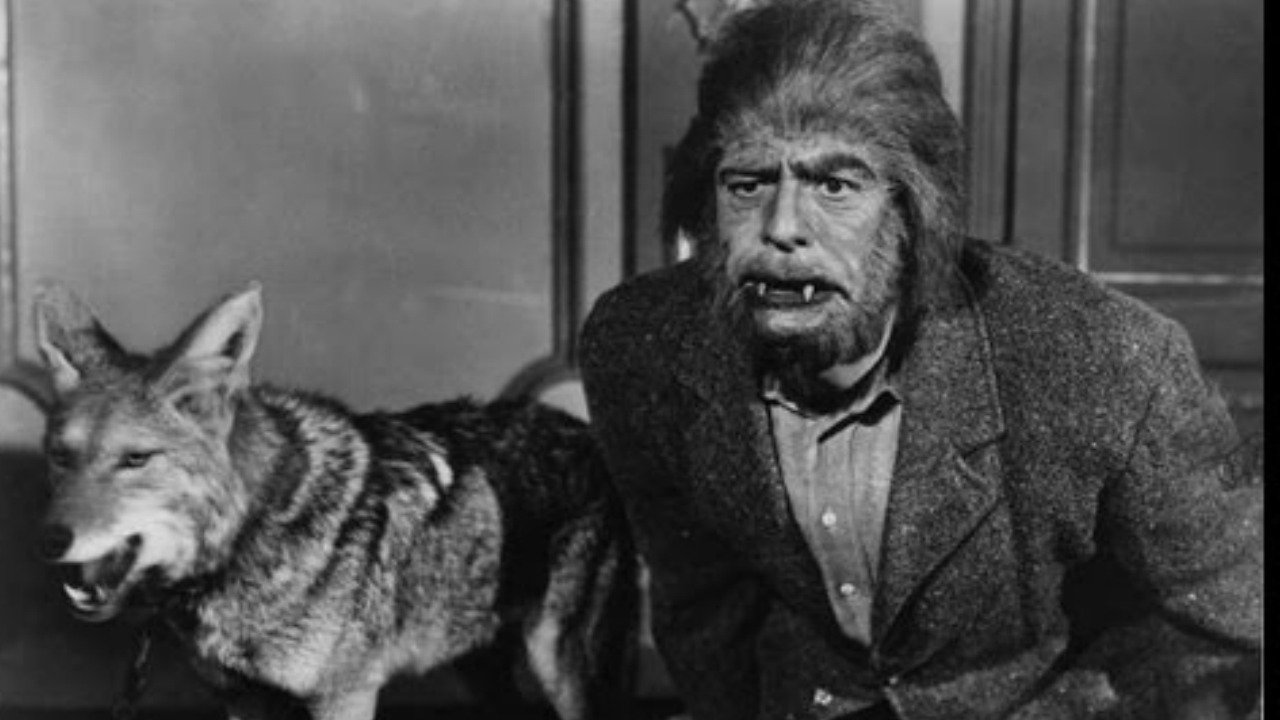
Waching the match with furry friend.

One of the few redeeming features of this mostly enjoyable cheapie is that it does make Bride of the Atom look good. Strange’s werewolf lumbers around the same 30 odd square foot of forest/swamp, searching around a bit randomly without a hint of animal about him, a few snarls aside, unlike Lon Chaney Jr’s hunched, animal-like gait from the year before. He just looks like a hairy bloke who’s lost And Strange’s make-up really hasn’t much going for it either. Petro wears a pretty rotten wig in his human form as it is, while his lupine form finds itself with some hair glued to the face, false teeth and maybe a bit of a heavier brow. It looks cheap and perhaps sets a standard for cost effectiveness when depicting werewolves. Harry H. Corbett’s werewolf from Carry on Screaming seems to have gotten its cues from here.

Strange’s Petro also ironically seems t channel a different Chaney Jr role, that of Lennie from 1939’s Of Mice and Men, right down to the dungarees. Petro’s shape is that of a hulk, with ridiculously broad shoulders adding to Strange’s already imposing 6’3’’ height. There is a slightly different approach to some of the transformation scenes, where Petro's head slumps down as he falls asleep.One crafty dissolve later and he raises his head to reveal the monster they paid for.

Werewolf in a hat. As you do.

Production value is stretched, the script is flat, shouldering the cast with some abominable lines that sound like they shouldn’t be spoken, and scenes kind of just end. After the glory of a couple of Universal monster movies, the next film was bound to slip, even though Glenn Strange was about to find some success of his own in following in Boris Karloff's oversized footsteps as Frankenstein's monster. But The Mad Monster is mostly rubbish on its own terms.

Friday, 2 October 2020

An American Werewolf in a Phony ̶E̶n̶g̶l̶i̶s̶h̶ WELSH Town


Spoilers follow, as they likely will for all entries in this run of blogs.

 Well, if you're watching werewolf movies for a month (what have I done?), you can’t go wrong with The Wolf Man (1941), directed by George Waggner and written by Curt Siodmak. One of the old titans of werewolf films, it still has some power where many of my own generation can only mention American Werewolves in English cities.And I still love this film.

 It’s only been a few years since I last watched it and yet I saw more this time. Particularly, Lon Chaney’s tragic Lawrence Talbot is introduced to us as a peeping tom. His casually mentioned (and never again mentioned) expertise working with optics leads him to help set up his father’s telescope in their stately home which the producers seemed to think looked like what they thought might be a castle. No sooner is dad out of the scene than old Larry is scanning the quant “English” village (more on that later) and settles on the bedroom of sort-of-love interest Gwen Conliffe (Evelyn Ankers). He pursues her with some cryptic questioning that made me slightly shudder. No wonder she said no. but Larry’s no quitter, even though Gwen is engaged to Patric Knowles’ solid, dependable Frank.

 We should all know how this goes, as Larry & co go for an evening walk and come across Maria Ouspenskaya and Bela Lugosi’s gypsy caravan and try to get their fortunes told. But with Bela being a werewolf and all, well, one werewolf attack later, Larry has been bitten by Bela (playing a man called Bela) and the curse has jumped bodies once again. Larry is consumed with guilt at killing Bela and this guilt comes to define the character in this and his subsequent cinematic appearances. The body count is remarkably low, however, until the end where Claude Rains’ father figure intervenes and bashes in his spawn with his own walking stick. It should be noted that Maria Ouspenskaya is fantastic every time I see this film, bringing some grounded emotion and dignity among the pained tragedy and phoney non-English accents. Virtually none of the leading men, dressed in very US cut suits, attempt anything resembling a UK accent, and that’s maybe for the best.


 Chaney’s performance ranges from cocky scion to tragic child – there are times when a kind of boyish innocence comes across, even though Chaney was a big man. That’s something that always came to mind – for his size as a human performer, I always thought his Wolf Man seemed smaller, and not just because he crouched to achieve something like a more animalistic gait; he just appeared to be a smaller man under Jack Pierce’s stunning make up. But in Chaney's first transformation scene, he takes his white shirt of as he starts to transform, only to be somehow wearing a buttoned up dark shirt when on the canine prowl. Did the Wolf Man stop to get dressed before jumping out the window? I was curious as to why for both transformation scenes, we never see his face turn wolfish, only his feet, whereas the previous Werewolf of London not only gace us the generally recognised dissolve technique on the face, but also tried so,mething different by having a transforming Henry Hull walks past beams or dark objects in the screen, each hiding a cut where more make up was applied. But, as we'll see, the later Frankenstein Meets the Wolf Man remedied that.

 The images of the Wolf Man snarling his way through misty woods are well known but the scenes in the old English village where much of the action takes place are just distracting from a UK viewer’s POV. It’s clearly the same Universal backlot where previous Frankenstein films were shot, with a generic but also semi-gothic north European look to the architecture. In short, it all looks about as English as a kilt. But, it’s part of the Universal charm, I guess.

 I was saddened to discover what happened to Pierce after Universal let him go -  an act of the most short-sighted ignorance. Overtaken by the merciless Westmores (a name I come to dislike the more I read about them), he moved on to TV and B features and died largely forgotten and poor in the late 60s. His relationship with Boris Karloff seemed very warm and a clip I saw form an old episode of This Is Your Life featuring Karloff showed two old friends are reunited in a wonderful moment where Pierce came on to greet his old victim of the make-up chair. 

 Next up is Poverty Row production, The Mad Monster (1942), which has kind of a Doctor Moreau thing going on.

October - Month of the Werewolf!


I'm blogging again. God help us all. It's October, so that means Halloween, which means horror films. I guess, like Christmas, we make these things a month long now. And I like Christmas a whole lot more than Halloween. But why not embrace it? Setting myself a challenge this year (yes, I know, this has been said before) of watching at least one werewolf film a day for the month. Well, it's day 1 and I'm two lycanthropic features in already.

First up is Wolfblood - A Tale of the Forest, from 1925, directed by George Cheseboro and Bruce Mitchell. I believe it's the earliest surviving werewolf feature, with two previous entries now lost (The Werewolf, 1913, and White Wolf, 1914). It's a handsomely mounted silent production with nice performances which I found to be without the usual overacting and melodramatic grimacing typical of the silent era; which is not to say that realism is the key. But that being said, there is a good sense of location, with the story set in the forests of Canada, featuring some beautiful, stark imagery that wouldn't look out of place in the German Expressionist films of the time in Europe. The fact that it's shot in real, frankly majestic locations helps the film a great deal.

Here, the trees are both beautiful and intimidating, cutting sharp, black lines through the frame, sometimes thick and never ending, almost imprisoning the characters or sometimes thin and cut off at the top; we're dealing with rival logging companies and what looked like progress back then now looks like a reduced vision of the Tunguska event in 1908. The trees are broken and jagged at their tops, angry at the tiny people Cheseboro and Mitchell often place at the bottom of the frame. There's a feel that nature is a hostile environment that almost consumes our main character, Bannister (played by co-director Cheseboro) while he believes himself to be more wolf than man.

And that's where the inevitable disappointment comes in - there is no werewolf here, this is a melodrama. Bannister is gravely injured in a fight with the nasty boss of a rival company and requires a blood transfusion when discovered by his love rival, Dr Horton (Ray Hanford), a decent sort who saves the rugged man his fiancé is clearly more interested in. The only shelter is the nearby shack of a local bootlegger who refuses to donate his blood. He suggests using his wolf instead, so Dr Horton proceeds, all the while painfully aware (as we are, due to protracted close up shots of medical text) that there is a theory that any human who receives animal blood may exhibit the characteristics of said beast. And then someone seems to be killed by a wolf. Self-doubt ensues, as it seems to in werewolf movies (Lon Chaney Jr made a career out of werewolf-ish guilt and self-doubt).


Once this is revealed, Bannister's superstitious men turn their backs on him and he too becomes convinced that he's destined to walk the earth as an animal, nicely shown in a scene where he follows a vision of phantom wolves into the forest and almost to his doom over a 1,000 foot drop, only to be rescued by his boss and love interest, Edith Ford (Marguerite Clayton). It's all very much about what nature can do to a person if left out there too long. Well, from a 1920's perspective at any rate (give me some of that forested solitude, or a Hobbit hole of my own). The images of the phantom wolves, done by double exposure, are wonderful. Here, the fear of losing control to primal instincts is defeated by love.

Next up was Universal's Werewolf of London (1935) which I saw as a teenager, so obviously not seen by me for a very long time. In fact, I think this might be the very first werewolf film I ever saw, likely on BBC2 sometime in the mid 1980s; either this or Werewolf of Washington (1973), a very different film. It should obviously be noted that Universal studios will be making quite a few appearances on this blog series.

Werewolf of London is the first sound werewolf feature and brings in more of the tropes we associate with the sub-genre, particularly the influence of the full moon. Dr Wilfred Glendon (Henry Hull) is a botanist on a trip to Tibet to retrieve a specimen of a rare plant when he's attacked by a strange wild creature and bitten. Not too much is made of this on his return home to his much younger bride Lisa (Valerie Hobson - she must have been 18 to Hull's 45 years), who he neglects in favour of his research It's bleedin' obvious where that's going when Lisa's old childhood friend turns up, all tall, handsome and an adventurer pilot to boot.


While Werewolf of London is a full on werewolf film it's also a mad scientist film with elements of science fiction; some marvellous carnivorous plants populate Glendon's lab where ladies faint during feeding time, and he has his own version of Ring Home Security with a video phone operated by a telephone rotary dial. An almost steampunkish look, blending the tech of the time with futurey stuff. Warner Oland turns up, sans Charlie Chan make up, as another botanist suspiciously interested in Glendon's work. Wait, who was that werewolf that bit him again...?

Hull's wolfman is more obviously human in his appearance. There are apocryphal tales of Hull refusing to sit in Jack Pierce's make up chair for the original make up, which would eventually be used on Lon Chaney Jr as The Wolfman, but it seems they went ith a more human look so that other characters would recognise Glendon in his werewolf state.

His werewolf seems to have a bit more agency over his actions, donning a cap and long caot while prowling the streets at night for victims. He comes across as more of a Mr Hyde character this way, even making reference to Jack the Ripper in his choice of victims. Hull's wolfman even speaks, intelligently, as he meets his demise, before he reverts to his human appearance. Werewolf of London seems to work along the same lines as Frankenstein, a cautionary tale against tampering with nature; Glendon is a scientist, after all, with his own lab, complete with Tesla coil and giant frog eating plants. And it is with another scientist he must struggle with in order to try and maintain his own humanity. There was always a price to pay for being a scientist in these movies, and so Glendon pays the price not only for that but for also giving in to primal instincts. Such is the way of the werewolf.

A test of Jack Pierce's original make-up concept, which looks far more familiar than the one used, which would eventually give us Eddie Munster.

Monday, 21 September 2020

Watch This Space


I'm back.


Watch out for lycanthropic bollocks this October.


See you soon.


B