Showing posts with label Glenn Strange. Show all posts

Thursday, 8 October 2020

(More) Houses of Horror, Universally Speaking Part 2

 
House of Dracula (1945) is not great. It’s creaky as hell, but at least there’s more Dracula and he is integral to the plot, until he’s done away with. A film of two distinct halves, for sure. Earl C. Kenton returns to direct one of the last (if not the last) films of Universal’s horror/monster cycle. His direction doesn’t seem quite as assured as his previous entry, House of Frankenstein (1944), and this one seems to resurrect all three monsters without any explanation. When we last saw them, Dracula had come a cropper off a horse drawn coach and shrivelled in the sunshine, the Wolfman was shot "dead" with a silver bullet by his love, and Frankenstein’s monster sank into quicksand. At least we get a little hint of the Monster’s fate when they discover his corpse in a cave, along with the skeleton of Boris Karloff’s Dr Niemann. How they got from quicksand into a rocky cave is…ah, why should we ask? I do ask, why Dracula is even looking for a cure to his vampirism, especially when he has no compunction at seducing another victim and then turning the tables on the doctor trying to cure him.

 Driven by either co-incidence, or the unspoken fact the Onslow Stevens’ Dr Edelman is clearly a magnet for monsters who seek to be free of the respective curses, the film focuses on the good doctor, until a ropey blood transfusion involving Dracula, turns him into more of a Mr Hyde, jumping between good and bad incarnations as he either tries to save Lawrence Talbot (his curse is actually pressure on the brain…) or resurrect Glenn Strange’s Monster. It seems he’s successful with the former, but things go awry when the Monster witnesses Edelman murdering his hunchbacked assistant, Nina (Jane Adams). Scoliosis seems to be quite the rage in Visaria, even if Nina’s own affliction looks remarkably convincing as a real case of scoliosis. In the ensuing chaos, guns are fired and the mob attends with the usual aplomb; Skelton Knaggs (possessor of one the greatest names in film history) gurns and grimaces his way through it as leader of the mob. Universal stalwart, Lionel Atwill, in one of his final roles, gets a dynamic send off when he’s thrust into an electrical circuit, but the castle falls prey to the usual destruction


 In terms of the Wolf Man, there is some fun to be had but not as much as usual. What differs is his initial transformation in a police cell is witnessed by the other characters, leaving his curse in no doubt to the others. There is the usual scene of Talbot sitting in a garden, bemoaning his curse as the attractive female lead finds him, sits down and pours pity on him. All getting a bit samey. Chaney first turns up dressed very differently than in previous entries, looking almost like a London spiv from the Second World War, black shirt and white tie and moustache. Story goes that Chaney was drinking a lot during this shoot and got Glenn Strange hammered when he had to lie down in the freezing cold for an extended period (I would presume it's during the scene in the cave where they find the Monster). Convinced booze would warm him up, Chaney slipped him booze throughout the day. Once the scene was in the can, Strange was so pished he couldn't stand up.


 Speaking of Strange, Frankenstein’s Monster is given particular short shrift, only coming to life in the film’s final moments. The poster has the same rogue’s gallery as the previous film to invite the audience, just with a few different faces with the same labels. But it feels like it’s all run its course here. The end was surely in sight for the Universal Monsters…

Wednesday, 7 October 2020

Houses of Horror, Universally Speaking: Part 1.


Misleading poster - no beard on this film's Hunchback!

 I found House of Frankenstein (1944) to be a bit of a delight. I was cautious after previously only lasting around 10 minutes when watching House of Dracula (1945) a few years ago. Some of my students are fanatical about the current shared Marvel Cinematic Universe - I had great fun and some real nostalgic kicks myself when I saw superheroes from my childhood together in Marvel’s Avengers back in 2012 – and so they have a bit of an awakening when I tell them that it was Universal Pitcures who came up with the idea of a shared universe on film 70 years earlier. House of Frankenstein was to horror icons what Thanos’ hunt for Infinity Stones is to superhero movies. And what brings this film to my werewolf list is the presence of one Lawrence Talbot. The events of Frankenstein Meets the Wolf Man (1943) are directly referenced here, making this a direct sequel to that the the previous Wolf Man (1941) and this pretty much a set of movies all connected by the life and fate of Chaney's Wolf Man.

Director Earl C. Kenton keeps things moving along nicely, with some engaging direction. Karloff’s own entrance is great, as his arm whips from a prison cell to strangle his jailor. There is a lot of fun to be had here and Kenton knows exactly which world we’re in. There's a great stunt moment where J. Carrol Naish's hunchback falls beneath some loose rocks in a cave, mid-dialogue and wonderfully timed, well into the shot. And of course there's some juicy, fun dialogue through the proceedings as well.


Yes, it’s immensely silly and the part with Dracula seems tacked on to the beginning as he seems to be there to simply get the mob off the tail of Boris Karloff’s splendid Dr Niemann and his sympathetic hunchback assistant, Daniel (J. Carrol Naish). The entire sequence featuring Dracula and his intended victim is interesting but seems like a separate little film of its own, and once the Count is dispatched the other relevant characters, including Universal Horror stalwart Lionel Atwill, are never seen again. I never bought John Carradine as Count Dracula. Maybe it’s the ‘tache. Or the top hat. Or he just doesn;t suit the role? There are some decent shots of his shadow transforming into a bat; it appears this iteration of the Count prefers to use his bat form to feed on the less attractive male characters, like the true vampire bat.

 The evil Dr Neiman seeks to recover the records of the late Dr Frankenstein so he might continue and improve on his work on resurrecting the dead. Or more like a chain reaction of brain transplants – it does get a little bit difficult to remember which brain is going into what body later o in the film, to the irritation of Lon Chaney Jr’s recently defrosted Lawrence Talbot, found alongside the also frozen Frankenstein Monster, this time played by the giant Glenn Strange, who we recently watched in The Mad Monster (1942). I’d spent many years being a bit cynical about Strange as the monster but he does well, certainly better than Lugosi (as of this writing, I am still to see Chaney’s take on the character), evoking more empathy for the Monster than anyone since Karloff. They may have dropped in one or two of Karloff’s snarls from the first two James Whale films. Another cast member from that Poverty Row effort is George Zucco, here playing Professor Lamprini. Or he does for a short scene before Karloff does away with him and assumes his identity. The entire opening sequence of the film does give us some characters which seem to be cast aside early on.

And so, we once again encounter Lawrence Talbot and his impatient desire to die and be free of his curse. His pleas are met with broken promises by Karloff’s mad scientist, while the hunchback Daniel’s gypsy* travelling companion, Ilonka (Elena Verdugo) falls for the tall and tragic “Larry”. Jealousy ensues, with Daniel now developing a hatred of Talbot and the Frankenstein Monster as Neiman’s promise to fix his physical deformity have been cast asunder in favour of darker experiments. A neat little moment where Daniel takes his temper out on the Monster brings back memories of Dwight Frye’s original hunchback assistant, Fritz, torturing Karloff’s Monster in the original Frankenstein (1931). But here, instead of blind hate, there is some understanding of where his violence comes from.

We have an interesting and different take on Talbot’s transformation into the Wolf Man, as we follow his footprints change from human to werewolf in the mud as he takes off into the night. Another full-face transformation is also terrific, with Jack Pierce’s make up looking even better. 

Of course, it all ends in tears, as lovers destroy each other and Daniel is tossed from a window like a ragdoll by the Monster, before the mob chase him down as he carries the wounded Neiman off into the woods, only to be swallowed up by quicksand. Cue credits. A top time has been had. It;s a bit strange how thes emovies often have no coda. Monsters are despatched and then it's immediately all over.

This has also encouraged me to try watching House of Dracula again. Let's see what happens…


*Any uses of the word “gypsy” by me in these blog entries are not intended to be offensive but reflect the simple-minded portrayal of Romani culture of the time and tone of the films.

Saturday, 3 October 2020

The Monster is Mad


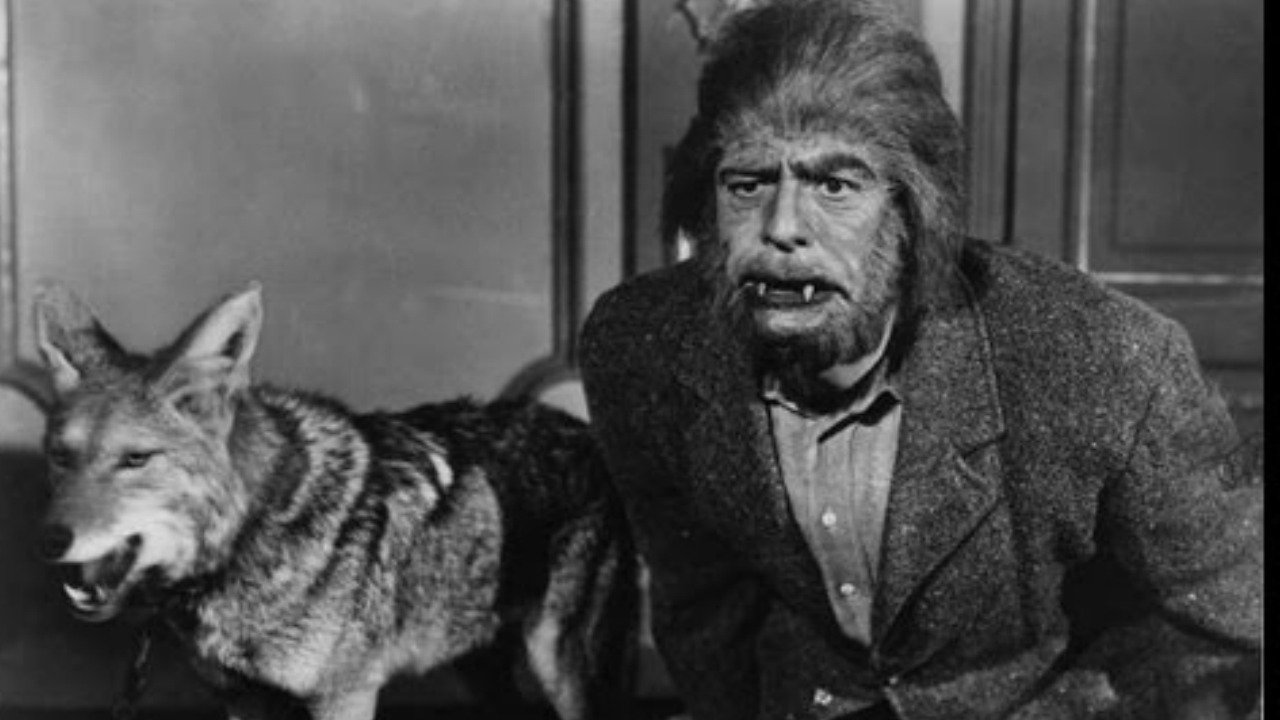
The Mad Monster (1942) looks like exactly what it is: a cheap quickie attempt to cash in on the success of The Wolf Man the previous year. Starring English actor George Zucco as a mad scientist hell bent on eliminating his enemies via innocent Petro (Glenn Strange), his dim witted assistant to whom he has been administering a drug made from the blood of wolves which turns him into, you guessed it, a werewolf.

Where this differs from other early werewolf movies is that it functions as a werewolf creation tale. The idea of the werewolf is centuries old and its cinematic depiction normally deals with an ancient curse passed on through injury. But here we have an actual “scientific” origin for our featured werewolf, having been injected with some concoction created form the blood of wolves, an idea not dissimilar to the one introduced but never explored in Wolf Blood – A Tale of the Forest (1925). Well, maybe an origin in the same way Prometheus (2012) is a xenomorph origin. Or not...

Our villain here is not a curse but a mad scientist, George Zucco’s Dr Lorenzo Cameron, who engages in activity that might arouse the interest of H.G. Wells’ Doctor Moreau, but without any desire to test what it means to be human. Here, Dr Cameron is all about creating an army of monster men that he can use as a weapon, his first targets being his fellow scientists who mocked him. Revenge!! Kind of a dress rehearsal for Bela Lugosi’s crazed scientists as featured in some of Edward D. Wood’s later z movies, like Bride of the Atom (1955). Zucco’s tirade against his imagined enemies is fairly amusing. A scene where a young girl is killed has potential but is squandered in subsequent scenes as the bereaved family seems, well, fine.

Waching the match with furry friend.

One of the few redeeming features of this mostly enjoyable cheapie is that it does make Bride of the Atom look good. Strange’s werewolf lumbers around the same 30 odd square foot of forest/swamp, searching around a bit randomly without a hint of animal about him, a few snarls aside, unlike Lon Chaney Jr’s hunched, animal-like gait from the year before. He just looks like a hairy bloke who’s lost And Strange’s make-up really hasn’t much going for it either. Petro wears a pretty rotten wig in his human form as it is, while his lupine form finds itself with some hair glued to the face, false teeth and maybe a bit of a heavier brow. It looks cheap and perhaps sets a standard for cost effectiveness when depicting werewolves. Harry H. Corbett’s werewolf from Carry on Screaming seems to have gotten its cues from here.

Strange’s Petro also ironically seems t channel a different Chaney Jr role, that of Lennie from 1939’s Of Mice and Men, right down to the dungarees. Petro’s shape is that of a hulk, with ridiculously broad shoulders adding to Strange’s already imposing 6’3’’ height. There is a slightly different approach to some of the transformation scenes, where Petro's head slumps down as he falls asleep.One crafty dissolve later and he raises his head to reveal the monster they paid for.

Werewolf in a hat. As you do.

Production value is stretched, the script is flat, shouldering the cast with some abominable lines that sound like they shouldn’t be spoken, and scenes kind of just end. After the glory of a couple of Universal monster movies, the next film was bound to slip, even though Glenn Strange was about to find some success of his own in following in Boris Karloff's oversized footsteps as Frankenstein's monster. But The Mad Monster is mostly rubbish on its own terms.