Showing posts with label werewolf films. Show all posts

Tuesday, 27 October 2020

Werewolf Woman meets Wolfman. We all lose.


  As with any sub-genre, it doesn’t take long before you come across something manky. Werewolf Woman (1976), by Italian director Rino Di Silvestro, is a pretty nasty exploitation piece that veers almost beyond soft-core porn and is ultimately a pretty nasty film.


   Annik Borel plays Daniella, a woman repelled by sex after being raped when she was younger. This is combined with an obsession about a dead relative to whom she bears a striking resemblance, who was purported to be a werewolf. The film begins with a dream/flashback to the female werewolf, Di Silvestri taking full nasty advantage of the idea of a woman becoming a feral being, complete with full female frontal nudity and even a closer shot of an area normally deemed off-limits in mainstream cinema. She transforms, furry breasts and all and is hunted by the typical mob, killing one of them. Daniella wakes up screaming. Not long after, her sister and her boyfriend turn up, him looking identical to the victim from Daniella’s dream. She spies on them having sex, which pushes her into a crazed attack on the boyfriend later, killing him and blaming it on local dogs. She doesn’t become a werewolf but is always naked when her feral attacks are made, biting and tearing.She soon escapes from a hospital to go on a voyeuristic killing spree.


It’s an unpleasant film that seems to treat the trauma of rape as an excuse to have a naked woman brutalise others; when Daniella is hospitalised, every other female patient seems to be a nymphomaniac. She does find peace for a shirt time with a man she falls in love with, but a wholly unnecessary gang rape sequence removes this joy from her life, resulting in a hasty revenge sequence. The scenes of violence against her would be more difficult to watch of they weren’t to incompetently filmed.

 Grubby and unpleasant.
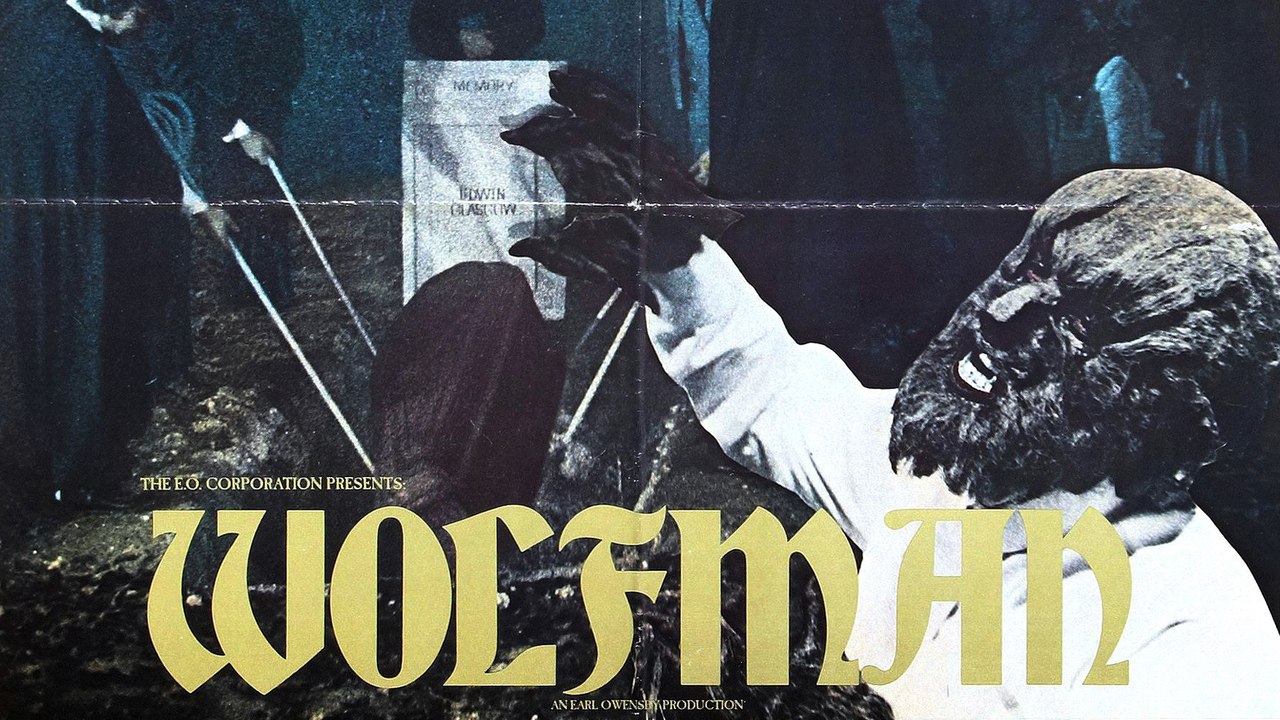


  Wolfman (1979) was a vehicle to showcase the acting talents of producer Earl Owensby and, on that front, it certainly showcases…well, something. Owensby made films that went to the drive-ins of the 70s, mostly very cheap with actors who possess little to no experience. I did see one of his later films rented on VHS when I was a kid, Gremloids (1984), a cheap attempt at a Star Wars parody, whose only real virtue was giving us Lord Buckethead, who has become a staple of the UK election cycle.


  Owensby plays Colin Glasgow, who has come home to attend the funeral of his father, who we already know has been murdered by Colin’s cousins and a minister who also all happen to be Satanists. Seems there is a werewolf curse they want to pass on to Colin, for reasons we are never truly told. The curse is passed on to Colin and deaths ensue. It’s all meant to take place in the 1910s (?) and attempts a Gothic horror feel, which never feels authentic in any way. This is really cheaply made stuff, shot either on location or in a cheap studio with concrete floors (some high angles give them away, where floorboards should clearly be); no one sounds like they're in the corridors we're meant to believe they are. No work for Foley artists here, it seems. Most, if not all, of the actors are not professional – this should never be a flat reason for dismissal, but just about everyone here is awful. Extras and some victims in the torch wielding mob look like they’ve not even bothered to dress for the period, and bits of set wobble. Owensby’s werewolf is your typical hairy-faced, black snouted wolfman, with dissolve transformations taking just 3 shots, the middle of which he just looks like an ape-man. Owensby’s own central performance is dismal to the point of incredulity. He simple cannot act and his southern drawl is at odds with the location and tone he’s looking to achieve, coming off like Lee Majors after a severe head injury.


This is really only about one step above Troll 2 (1990) territory, but nowhere near as much fun. A cheap, shoddy vanity project, but I suspect it made money due to Owensby’s production methods, similar to Roger Corman, except Corman would employ talented people.


Damn, I hate ragging on films, but these were just awful.

Friday, 16 October 2020

Mark of the Wolfman aka Frankenstein's Bloody LIES!


 Breather was a bit longer than anticipated. But I return.

 Spain’s Paul Naschy is a name that’s popped up quite a few times when compiling a list of werewolf movies to watch – it seems, to date, that he’s portrayed werewolves more than any other actor. Real name Jacinto Molina Alvarez, he was advised to change his name for international markets by the German distributors of this, his first werewolf move and also his first appearance as the mysterious Waldemar Daninsky. He would play the part another 11 times, each film unconnected to the others, So, he could be killed at the end of one film and then just turn up in the next with no explanation; not unlike Lawrence Talbot and Dracula in House of Dracula (1945), after they were seemingly permanent demises in House of Frankenstein (1944). Logic’s not always great, and that’s just as applicable here in La marca del hombre lobo (1968), which translates as Mark of the Wolfman. The version I managed to see was actually titled Frankenstein’s Bloody Terror and promises a Frankenstein Monster which becomes a wolfman!  This does not happen. Nope.


 Waldemar is bitten by a formerly dead werewolf, of the family Wolfstein (as close as this affair gets to the broken promise of a lycanthropic Frankenstein), after he is accidentally by a drunken Romani couple seeking shelter in his ruined castle. Now cursed, he seeks help from his two “friends”, Rudolph and Janice, only after stealing Janice from Rudolph, as is the way with mysterious chaps like himself. They call on two strange doctors, who claim they can help cure Waldemar, but in fact turn out to be vampires who want Waldemar’s werewolf for, well, it’s never really explained. Even less makes sense after this turn of events, with the original werewolf somehow resurrected again for purposes as unclear as anything else.

   The version of the film I saw was dubbed, atrociously, with the entire soundtrack replaced with some weird 60s sounds that were quite distracting. I’d be interested in seeing it in the original Spanish, with its original soundtrack intact. Scenes in this version also play out strangely, sometimes just ending. Other times characters appear in the next scene in a totally different location, seemingly at the same time, and then they jump back conveniently to the original location, as though someone got happy with a razor blade if re-editing for other markets. Hairstyles change sometimes instantenously between scenes that take place immediately after the previous one. I cannot stand dubbed films, unless they involve Kaiju in the 1960s (gimme some of that Showa Toho energy!). But this kind of dubbed crap appraoch is the ultimate phoniness.

 There’s a decent sense of gloom across the film, even with the garish and slightly overdone production design. We get treated to Waldemar’s first transformation through a weird, blurry lens effect. The make up design is not bad, clearly your average wolfman, but the difference is in Naschy’s wild performance, as he jerks unpredictably from side to side, almost like a crab, on his haunches. His first victims, who coincidentally speak to each other about werewolves just as Waldemar burst into their cottage and engages in what a police report might refer to as a frenzied and sustained attack. Naschy’s werewolf is a little dynamo, full of manic energy. He would play the part again and I’m intrigued as to what the rest of his films are like.But good to see werewolf films from other parts of the world.

Monday, 12 October 2020

Moon Shadows & Dust - Curse of the Werewolf


Moving on to the 1960s, it wasn’t just the US studios who were going back to the werewolf well. And this is, I think, my first non-US werewolf film of this blog series. UK studio, Hammer, was beginning to carve out a solid reputation as horror filmmakers, after The Curse of Frankenstein (1957), Dracula (1958) and The Mummy (1959) amongst others, and so it was only natural to turn to the next obvious monster icon, the Werewolf. But no Christopher Lee as the titular monster here. Hammer were after younger blood for this beast.


1961’s Curse of the Werewolf is another one of those films I’ve been wanting to see since I was a kid. The images of Oliver Reed’s werewolf were striking, with that kind of contained cruelty I felt Reed’s face contained now fully unleashed; I always felt intimidated just by his face, no matter the role. But this was quite the disappointment. It takes a full 50 minutes for Reed to even appear in the film, with the first half dealing with the origins of his characters, Leon, being born of a mute serving girl (Yvonne Romain) who was raped by a mad imprisoned beggar, in 18th century Spain. Given sanctuary by a kindly don (Clifford Evans), she dies in childbirth and Leon’s baptism is accompanied by lightning and a demonic presence. This werewolf’s curse is bestowed upon his baptism, giving the proceedings a very Catholic guilt/original sin feeling. Once again, our werewolf has done nothing to deserve his curse, other than being conceived in violence and born on Christmas Day.


What follows when Reed does turn up, is the kind of stuff we’d expect to see far earlier in the film, giving the whole thing a very odd pace. The first half is slow as hell while the second half feels rushed. Bright Young Thing of the time, Oliver Reed’s performance seems dominated by histrionics and director Terence Fisher doesn’t seem to realise the pure threat contained in Reed’s general demeanour. Roy Ashton’s make-up allows Reed’s performance to show through (the fur looks very different than anything I've seen so far, wiry and feral) but it’s also very blocky in its design, looking like he can’t turn his head. It does cut a fine silhouette, though, and works well in a great close shot where he hauls himself into a bell tower in the film’s climax. This make-up does seem more savage in its appearence to me and there is far more blood in this film than in any previous werewolf films I've watched - the BBFC were not happy about this film. But, Curse of the Werwwolf could have been so much better with a differently structured screenplay to give it all a bit of breathing space. As such, there’s not a great deal of tension and it's ultimately disappointing. But it’s a Hammer film, so there is obviously an appearance from Michael Ripper, which is always oddly comforting.